As anyone can tell, I am an avid fan of neuroscience yet I have never really spoken about neurosurgery which is just or even more fascinating. What better way to start discussing topics about neurosurgery than discussing emergency issues, something I also enjoy discussing.
When understanding head trauma, we must first talk about the rigidness and the detailed biology about the adult and even the adolescent skull. Unlike an evidently expanding abdomen (which would be soft) a cranium is a fixed vault of solid bone. Inside the cranium there are three primary components that share a quite limited volume. Starting off with the brain tissue and intracellular fluid(also known as brain parenchyma), which takes up around eighty percent of the brain, and then the blood and cerebrospinal fluid, which each take up the remaining twenty percent. Another doctrine, known as the Monro-Kellie doctrine started that since the skull cannot expand the total volume inside should remain constant. Yet, traumatic impact is still able to introduce a fourth element, usually a swelling brain or an unusually rapid growing blood clot (known as the epidural/subdural hematoma) another substance in the brain has to yield to break through. Adding on to this, when a brain injury does occur the body immediately attempts to adapt to this added mass through two main spatial compensation mechanisms. The primary being CSF displacement, where excess cerebrospinal fluid is squeezed out of the cerebral ventricles and down into the spinal tecah. The latter is venous compression, where low pressure cerebral veins and dural sinuses are compressed, which forced blood out of the skull into the internal veins. During this immediate stage, patients actually remain weirdly stable. Continuing, as the bleeding and swelling the spinal fluid and blood shift away, and then intracranial pressure remains. Yet the high pressure inside the skull is not just uncomfortable. This pressure completely limits the brain cells of oxygen. Brain tissue relied entirely on CPP(cerebral perfusion pressure) to deliver oxygenated blood and glucose across capillary beds. CPP means the pressure gradient that drives blood flow through the brain, calculated in the following equation.
CPP=MAP-ICP
ICP is intracranial pressure, which when disrupted compression tissue and vital microvasculature. MAP on the other hand stands for the mean arterial pressure which when disrupted completely drops during systemic shock which reduces pushing force towards the brain. CPP when disrupted causes oxygen starvation, clinically known as cerebral ischemia.
Now, neurotrauma clinicians divide traumatic brain injury into two phases, primary and secondary. The primary phase is whenever the immediate damage is caused by physical impact and happens in milliseconds. This cannot be reversed yet it can be repaired. Secondary injury is when destructive cellular mechanisms that unfold over hours and days following the impact.
There are also two types of brain swelling, also known as cerebral edema due to low CPP. The first is Cytotoxic edema, which is when sodium rushes into the brain cells to pull water in through osmosis and causing individual neurons to swell due to lack of oxygen disabling the cells ATP dependent membrane pumps. The second type id when inflation breaks down the blood brain barrier. This means plasma proteins leak out of damaged white blood vessels into the space which draws fluid into the surrounding white matter. As the swelling progresses, any unchecked pressure can cause brain tissue to be forced through internal bony boundaries which is also clinically known as brain herniation.
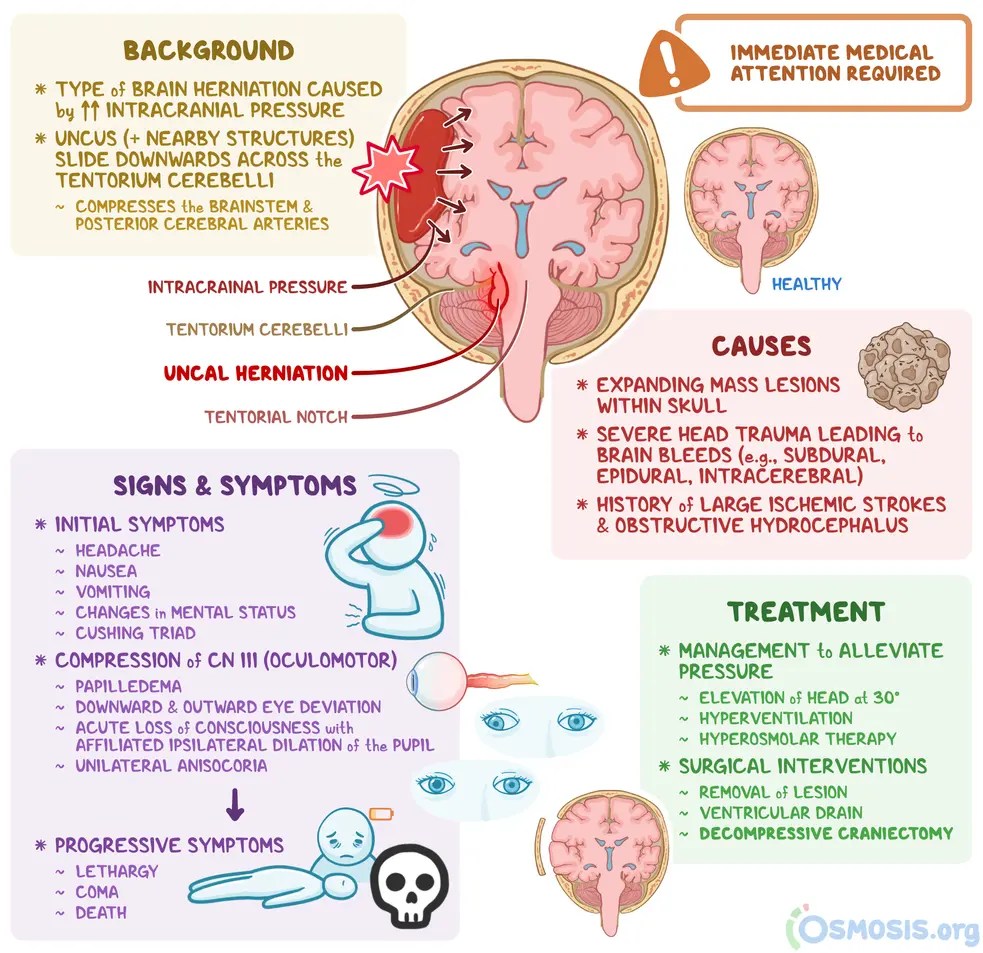
Now coming back to the clinical treatment side, managing acute terminal brain infections is essentially surpressing ICP levels while keep CPP above it’s optimum amount. The main interventions medicals team use are the following;
CSF Drainage, Osmotic Therapy, Controlled Hyperventilation, Surgical Decompression and optimizing venous drainage.
I seriously believe traumatic brain injury is truly a highlight on how closely physics biology and surgical medicine can all closely come together and work off each other, and the precision and detail into this subtopic is really breathtaking, with several layers of depth I would likely never be able to cover. Truly wonderful.
 Scrubbed In Chronicles
Leave a comment